Document · 168 blocks
Dyna-2: A 1-Million-Hour Scaling Law for World-Action Models — DYNA
A world-action model pre-trained on 1,000,000+ hours of human video demonstrates scaling laws that hold on human and robot evaluation alike — and the many technical insights behind it.
Figure 1. Dyna-2 is a world-action model (WAM) pre-trained on over one million hours of human video data. It exhibits scaling laws on held-out human data, and for the first time, proves the existence of a human-to-robot transfer scaling law. Every clip in this mosaic is generated by Dyna-2 itself.
Held-out human data
Zero-shot Robot Data (No Robot Data In Pre-Training)
Figure 2. Scaling laws for Dyna-2 world-action models trained on a ladder of human video data, from 1000 hours to 1000000 hours. Not only Dyna-2 exhibits scaling trends on held-out human data, it also demonstrates the emergence of human-to-robot transfer scaling law on robot data the model has never seen during training.
§ 1 Introduction
Excitement about general-purpose robots has never been higher, and scaling robot foundation models has been the most promising path to them. Yet the field has no consensus on the most basic questions about how to scale data and models. Perhaps, the set of these questions can be asked in a sequence:
The field has explored several sources of pre-training data for robot learning, most notably teleoperation and specialized capture devices. Both yield valuable, action-labeled data that we collect and train on ourselves. But each hour of that data has to be deliberately produced, which bounds how far it can carry pre-training on its own. From first principles, we believe the answer follows from the goal itself: a general purpose robot should eventually be capable of doing any economically valuable task that is currently being done by humans. The right source of pre-training data, therefore, ought to be sensorized recording (e.g., video) of humans performing those very tasks, which already exists at effectively unbounded scale and carries exactly what a manipulation policy needs to learn: how scenes evolve, how objects respond to contact, and how a hand interacts with them. Now, while learning from humans may present an embodiment gap today, we believe that if any transfer scaling law can be established (i.e., a scaling law on human data implies a scaling law on robot data), then the technical path forward from here on can be relatively well-defined: gather more sensorized human data, while making our robots closer to humans in form-factor.
Today, we introduce Dyna-2, our new flagship world-action model (WAM) [4] pre-trained on more than one million hours of egocentric human videos — roughly 170 years of continuous waking experience. Dyna-2 establishes several novel and surprising scaling laws that speak directly to the questions posed above. Specifically we find that
Furthermore, beyond these highlighted offline scaling law results, we find that the scaling-law trend transfers to on-robot performance in post-training. With just a few hours of robot data alone in post-training and without seeing any robot data during pre-training, post-trained Dyna-2 models can perform tasks across bi-manual parallel-jaw arms as well as semi-humanoid and dexterous hand platforms, and the relative performance is consistent with the offline robot scaling law. In one striking example, we found that a mere 10 minutes of teleoperation data was enough to fine-tune Dyna-2 to do bottle cap opening using two five-fingered robot hands. In addition to scaling law related results, we also showcase several novel capabilities of Dyna-2, including enhanced robustness, precision, instruction following, zero-shot production-grade performance, and one-step video generation. Overall, Dyna-2 is a significant improvement over our prior models. At the same time, it offers some strong empirical evidence that helps answer some open questions in the field and can serve as a strong reference for future research.
§ 2 Model architecture and training objectives
Dyna-2 is a world-action model [4]: a single generative model that can denoise future video and future actions jointly or separately, built on a video-diffusion backbone. Architecturally it is a mixture of transformers [2, 3, 28]; each input modality, including video and action, is tokenized individually and has a distinct set of DiT layers [27] that can attend to each other via attention operations, while proprioception is tokenized and fed directly as input to the action transformer. Video tokens use causal masking; action tokens use bidirectional self-attention (no causal mask) and attend to the video tokens of the observed context. Video tokens cross-attend to text tokens; text does not directly influence action tokens.
Figure 3. The Dyna-2 architecture diagram.
In our early architectural probing, we find that DiT-style video diffusion architectures retain most of their temporal reasoning capacity in the early layers [1]. Therefore, we deliberately design the action transformer to have shallower depth, and only join the video stream at the early layers. We find doing this substantially improves the model's real-time inference latency without sacrificing performance.Dyna-2 employs flow matching [18, 19] to train the model. Specifically, let c be the conditioning context (past frames, proprioception, and the language instruction), z the latent future video, and a the future action chunk. Following the standard flow-matching setup, the model corrupts real samples from each modality along a straight path toward noise,
and trains a network uθ to predict the velocity that denoises the corrupted sample.For the variant of Dyna-2 models that we use to study the scaling law, the models are co-trained on video prediction and action prediction. That is, a video loss and an action loss sharing a trunk, but fit as two separate marginal velocity fields:
Because uθact never takes zt as an argument, the video loss can shape the shared representation, but at inference time the model stays reactive (i.e., the policy neither generates nor attends to predicted future video at inference time).
§ 3 The manipulation scaling laws: From 1,000 to 1,000,000 hours
We aim to answer the following questions:
We first describe the human pre-training data and the metrics used to evaluate the scaling law. Then we answer the four questions in order.
Pre-training data: nested, exact-hours subsets of human experience
We have constructed a corpus of human manipulation video totaling over one million hours to date. Most of it is head-mounted, first-person recordings of people performing everyday manipulation — cooking, tidying, folding, assembling — collected by our data partners as well as our own internal operation. We built a comprehensive data cleaning, hand-pose extraction, validation, and filtering pipeline to ensure validity and consistency across the various sources. For episodes that pass the hand-pose quality bar, their annotations contain 3D hand-pose tracks, from which we derive the pseudo-action supervision the action stream trains on: wrist poses for end-effector trajectories, and a continuous grasp signal derived from the thumb–index aperture. We do not perform any visual or embodiment-specific data processing to reduce the visual or kinematic gap between the pre-training data and the downstream robot data; our interest is to study model properties from scaling, and scaling alone. Therefore, we believe our findings are general and should also transfer to other embodiments not studied in this work.
Figure 4. Illustrative samples of the pre-training data. Thirty-six randomly drawn egocentric clips from the corpus, played simultaneously: everyday two-handed manipulation across kitchens, workshops, and living spaces, with both hands in frame.
One million hours at a glance
From this corpus we construct nested subsets of exactly 1,000, 10,000, 100,000, and 1,000,000 hours; identical proportion from each data source is kept. This way, a larger budget never exchanges data, only adds it, and differences between points on the scaling-law curves cannot be explained by distribution shift between subsets. A separate 100-hour validation set, disjoint from all training subsets, is held fixed across all evaluations on human data; all held-out numbers on human data are computed on it. Training and evaluation configurations are identical across all points, so the only variable is hours of experience. We leave compute and model-size scaling experiments for future work.
Evaluation metrics
Scaling claims can be artifacts of the metric used to make them: nonlinear or discontinuous metrics can unintentionally generate apparent emergence from smoothly improving models [7]. To ensure our scaling law is not sensitive to the choice of metric, we report it on two continuous errors and two discrete, thresholded accuracies. For a predicted action chunk â and ground truth a, we compute MSE and L1 errors, averaged over action dimensions and the chunk horizon, and accuracy@τ the fraction of action dimensions falling within τ of the ground truth (in normalized action units), reported at τ=0.5,0.1. In our internal research, we find τ=0.5 to be a good measure of general motion intent, suitable for studying human-to-robot transfer scaling law, and tighter thresholds such as 0.1 to be a good indicator of movement precision, informative of in-domain scaling trends (i.e., human-to-human).
Is there a scaling law for world-action models trained on 1-million hours of human data?
To study this question, we train Dyna-2 models on the ladder of data scale from 1000 to 1000000 hours of human data, as described above, and evaluate on the held-out human dataset. To remove checkpoint bias, we evaluate 10 checkpoints in a late-step window and report the mean as well as standard deviation on each metric. As shown in Figure 5, on every metric, held-out prediction improves monotonically, and each is well described by a power law in hours. This is a very important result, as it is the first scaling law for real-world manipulation data that validates up to 1 million hours; at the same time, it validates that our Dyna-2 architecture is sound and can absorb millions of hours of data and keeps improving through the million-hour scale. Together, these results confirm that physical interaction accuracy, when measured on the same embodiment (i.e., humans), can be predictably improved by scaling up the dataset to the million-hour scale.
Figure 5. Scaling laws for Dyna-2 up to 1-million hours of human data. All four scale monotonically, and the thresholded metrics improve fastest — accuracy@0.1 rises 51% across the ladder against 12% for MSE.
Does a scaling law on human data imply a scaling law on robot data?
The results above measure generalization to held-out human data to an unprecedented scale. But for robotics, a scaling law on human data is most meaningful if the scaling emerges and can be measured on robot data as well. To the best of our knowledge, there is no prior work that has demonstrated cross-embodiment transfer scaling law, meaning that we measure evaluation metrics on data from embodiments that are held-out from the pre-training set, without any additional adaptation or fine-tuning [6, 29, 30]. In our study, we aim to study pre-training just on human data and evaluate directly on held-out robot data. Specifically, we evaluated the same set of scale-laddered Dyna-2 checkpoints on a curated, held-out robot dataset. This robot evaluation dataset consists of 39 tasks on two distinct stationary, bi-manual YAM platforms; 12 tasks come from our internal stationary YAM bimanual benchmark, and 27 tasks from xdof ABC [31]; see Figure 6 for a random subset of the evaluation tasks. These two sources combine to 39 tasks in total, covering a broad distribution of everyday manipulation such as cloth handling, knot tying, packing, cleaning, food service, and assembly. We intentionally include external YAM datasets to make sure the evaluation is not biased toward the tasks we design ourselves. No checkpoint in this section has trained on a single trajectory from either source.
The zero-shot offline robot evaluation results are shown in Figure 7. Surprisingly, all metrics rank monotonically with the scale of the pre-training human data. To our knowledge this is the first scaling law demonstrated across the embodiment gap: held-out robot validation metrics falling monotonically as purely human data grows. We empirically observe an inflection point from 10k to 100k hours of pre-training, suggesting with sufficient coverage, cross-embodiment knowledge transfer may emerge from just scale alone.
Figure 6. Representative gallery of the offline robot evaluation tasks.
Figure 7. Dyna-2 demonstrates, for the first time, a human-to-robot transfer scaling law. Evaluated on robot data the model has never seen during pre-training, the performance predictably improves as human data scales.
[ KEY TAKEAWAY — SCALING LAW TRANSFERS FROM HUMAN TO ROBOT ]
A scaling law for world-action models can be derived from human data. Scaling human data alone can improve robot predictions for world-action models.
Does the cross-embodiment scaling law translate to on-robot performance?
Finally, we verify that our cross-embodiment transfer scaling law extends to on-robot performance. To do this, we post-trained equivalently stepped checkpoints from each of the 4 rungs in our scaling ladder on the same set of internal benchmarking task datasets of 14 tasks; each task comprises at most 10 hours of robot data. The only variable among the post-trained models is how many hours of human video were used in human-only pre-training. Note that unlike prior human-to-robot transfer results [6, 17], we deliberately do not perform human-robot alignment or co-training [17, 36]. We believe that doing so would likely yield better post-training performance, but our interest in this study is the improvement attributable to pre-training scaling.
The 14 tasks span several manipulation capabilities: precise pick-and-place (Pick & Place, Unsort, Trash Tray Pickup, First Aid Kitting), deformable-object manipulation (Rope Tie, Pants Hanger Preparation), precision (Food Scooping, Fridge Tube Insertion, Lockbox Key Turning), articulated-object interaction (Tote Construction, Mug Unboxing), dexterous multi-fingered manipulation (Highlighter in Drawer, Bottle Cap Untwisting), and language following (Targeted Drink Retrieval, in which the policy follows a typed instruction naming a specific drink to retrieve from a fridge). They run on three robot embodiments: 11 tasks use a stationary bimanual platform with 6-DOF YAM arms and in-house parallel-jaw grippers, 2 use the same arms fitted with a pair of WUJI-2 20-DOF dexterous multi-fingered hands, and the language-following task runs on an early prototype of our semi-humanoid robot. Task diversity brings different native metrics, so we report each task in its own native metric and, to place them on a common axis, normalize each to a fraction of the maximum attainable on that task (a 100% success rate, all ten objects on Pick & Place, or all six pieces on Trash Tray Pickup); the mean of these fractions across the 14 tasks is the single normalized score we use to build the scaling plot, where 50% denotes reaching, on average, half of each task’s ceiling. We evaluate the models for 10 trials (12 for the language-following task) per task using identical protocols in blind tests (i.e., the evaluators were not involved in the model development).
Highlighter in Drawer · dexterous
success rate ↑
Bottle Cap Untwisting · dexterous
success rate ↑
Trash Tray Pickup
avg trash picked, of 6 pieces ↑
Pants Hanger Preparation
success rate ↑
Rope Tie
knot-tie success rate ↑
Lockbox Key Turning
success rate ↑
Food Scooping
success rate ↑
First Aid Kitting
avg objects in correct compartment, of 10 ↑
Unsort
avg objects out of box, of 10 ↑
Fridge Tube Insertion
success rate ↑
Tote Construction
success rate ↑
Mug Unboxing
success rate ↑
Pick & Place
avg objects placed, of 10 ↑
Targeted Drink Retrieval · language
success rate ↑
Figure 8. Pre-training scale carries through post-training to the robot, and keeps climbing to the largest rung. Top: the mean normalized score across all 14 tasks on a log pre-training axis; below it, the individual tasks (use the slider to move through them), with bars for the four pre-training budgets.
Aggregated across the 14 tasks, mean normalized performance increases monotonically with pre-training scale, rising 20% → 28% → 45% → 53% of the attainable maximum. At one million hours, the post-trained models produced the strongest real-world performance overall and were the best on 9 of the 14 tasks. Several tasks appear to require a threshold amount of pre-training before they become solvable at all. Lockbox Key Turning is the clearest case: no checkpoint up to 100,000 hours turned the key. At one million hours, the key was successfully turned 90% of the time.Data efficiency is also striking at the other extreme: Bottle Cap Untwisting was post-trained on only roughly 10 minutes of robot demonstrations, yet still climbs from 10% at the smaller budgets to 40% and 50% as pre-training scales. The trend extends to language following, where targeted drink retrieval rises from 58% to 83%.Throughout, the post-training recipe is applied identically to every task: robot data only, with no co-training and no human-robot alignment. Within this recipe, the pre-training scaling law carries through to the physical robot across tasks, embodiments, and capabilities.
Figure 9. Example autonomous rollouts of the post-trained policies (top camera, 1× speed). Each policy was pre-trained on human egocentric video and post-trained on a few hours of the corresponding task's robot demonstrations only.
What matters for the cross-embodiment scaling law to emerge?
Dyna-2 is a world-action model that learns to predict both the future world state and robot action, but does this modeling choice actually matter?
Through controlled experiments, we empirically demonstrate that predicting videos is what (1) enables cross-embodiment transfer through scaling, and (2) video is a new scaling axis for embodied AI: scaling the amount of video-only data in pre-training also predictably improves held-out robot data evaluation.
We begin our investigation with a three-way controlled comparison that fixes the amount of action data and varies training objective as well as data composition. That is, for each fixed amount of human video data that contains hand-pose annotations, ranging from 5k, 50k, to 100k, we train identical Dyna-2 architecture with the following training recipes:
As before, all three ablations are evaluated zero-shot on the 39-task robot suite at matched training step. Figure 10 shows the result across 5,000 to 100,000 action hours. As shown, any form of future prediction beats action-only by a wide margin: the joint recipe beats action-only on 39 of 39 tasks at every action scale. Action-only also exhibits severe and unpredictable overfitting patterns as data scales; the joint variant overfits less but also does not scale with data. This trend is reversed only when the training data is augmented with a copious amount of human videos used only for video prediction. Notably, doing so in fact is not advantageous at small scale (i.e., 5k hours), but the gap grows as data scale increases.
Figure 10. World modeling is crucial for the emergence of human-to-robot transfer scaling law. Joint denoising beats action-only unanimously at every scale, and video co-training is the only recipe that improves as action data grows.
Video is the new scaling axis
The results above report a single video-data scale for each ladder of action data. The next natural question is what happens when you fix the amount of action data and just scale video data alone? This question is not just about scientific curiosity but also of practical importance. As we are entering million-hour scale pre-training data, one challenge we find is that while human videos can be abundant, extracting accurate hand poses is not easy; not all human activity recording setups can extract hand poses that pass our internal quality bar. Furthermore, even with good recording setups, running large-scale annotations on millions of hours of data is in itself a huge infrastructure challenge and creates a lag between the amount of total data versus amount of data that is action-labeled and quality-controlled. Therefore, it's safe to assume that in the regime of pre-training from human data, there will always be a large amount of un-annotated human video data. How can we effectively make use of such video data? What if these lower-quality video data need not provide action supervision and using them for future video prediction at scale is sufficient?
We find that the key benefit of video co-training is the emergence of cross-embodiment generalization that scales with the amount of video data. Specifically, we conducted an experiment where we fixed the amount of action-labelled human data to be 50,000 hours, and scaled only the amount of human data that contributed only to the video co-training objective from 0, 1,000, 10,000 to 50,000 hours, mimicking the scenario of having plentiful video data without action labels. To verify that the finding holds when both human-action and human-video-only data are one magnitude larger, we also repeat the experiment with 250k hours of human action data coupled with 0, 250k, 750k human-video-only data. Then, we compared these models on held-out robot data offline evaluations. The results are shown in Figure 11. Across two sets of fixed action-data amount and video-data scale, we see that pre-training Dyna-2 without any video data (i.e., action-only) consistently does worse than including video data, and scaling video alone leads to monotonic improvement on generalization.
Furthermore, we illustrate how these checkpoints do on the held-out human dataset by measuring normalized relative improvements in Figure 12. We see that scaling human video data has no impact and perhaps slightly worsens human data evaluations; one potential hypothesis can be that video training dilutes action learning gradients, and for on-embodiment evaluation, sufficient action-data is enough. Given all results in this section, the key empirical takeaway is that video co-training is the primary driver for establishing cross-embodiment transfer scaling law. While these results are surprising (at least to us), from first principle thinking, we also believe that these results ought to be true. The promise of world modeling has always been gifting the model a general understanding of the physical world; this capability should help the model generalize to completely unseen embodiments. And for the first time, this hypothesis is validated at scale.
Figure 11. Video is the new scaling axis. Across two magnitudes of human action data, scaling video data alone improves model generalization.
Figure 12. Video data's benefit at-scale is cross-embodiment generalization.
[ KEY TAKEAWAY — FUTURE PREDICTION ENABLES CROSS-EMBODIMENT TRANSFER SCALING LAW ]
Video is the new scaling axis.
§ 4 Additional Model Capabilities and Extended Analysis
While our primary focus in this research is studying emergence of scaling laws, Dyna-2 has many other interesting capabilities worth sharing. Specifically, we observe that Dyna-2 is all-around superior to our Dyna-1 models through a series of apple-to-apple comparisons, has instruction following capability that scales with both objective and data, and finally, can generate videos with just one-step inference. Note that the experiments here are conducted on our "production" Dyna-2 models, which use different training recipes, but we do believe all findings are general and hold for variants we trained specifically for scaling-law experiments.
WAM vs. VLA: an apple-to-apple comparison
In our march towards our final Dyna-2 recipe, we have also conducted a rigorous apple-to-apple comparison between WAM and vision-language-action (VLA) models [13, 3]. So far, there is no consensus within the community on which architecture is better, and empirical evidence is lacking. Published comparisons differ in training data, compute budget, evaluation protocol, and how hard each side's checkpoints were tuned [4, 37].
We compared an early version of Dyna-2 against Dyna-1, our prior production VLA architecture, in an apple-to-apple comparison setting. Dyna-1 employs a similar mixture-of-transformers architecture for action prediction, initialized from Qwen3-VL-4B [32]. We trained and compared the two models under matched conditions: the same pre-training and post-training datasets and training hyperparameters; each post-training run is initialized from three distinct pre-training checkpoints for each architecture to remove checkpoint-selection bias. It is worth highlighting that this comparison is in fact unfair for WAM. First, the early Dyna-2 tested here predates most of this technical report: no 1M-hour pre-training, and an action-only loss supervising the entire model. Second, and more fundamentally, the entire experimental pipeline is tuned for our VLAs: the datasets were collected and curated to the VLA recipe, training hyperparameters were inherited from our VLA tuning. We therefore read these results as a lower bound on what a WAM does against a well-tuned VLA baseline.
The aggregate results over 7 benchmark tasks are shown below. Pooled over all trials and checkpoints, the WAM reaches 1.55× the VLA's success rate and 1.12× its grade. In head-to-head comparisons — fixing both the pre-trained checkpoint step and the post-training task — the early Dyna-2 won 65% of the time, Dyna-1 won 29%, with 6% tied. Most of the VLA's wins come at the earliest pre-training checkpoint, before the WAM model's pre-training advantage had accumulated.
Figure 13. Aggregate on-robot comparison, normalized to the VLA. Each bar pools all seven post-training tasks and all three pre-training checkpoints — 21 task×checkpoint cells per architecture — with the VLA set to 1.00 on each metric. Left: on-robot success rate. Right: average quality grade. Whiskers are paired bootstrap 95% CIs over the cells (a ratio of means; per-cell ratios are undefined where the VLA scores zero).
Qualitative case study
In addition to aggregated post-training results, we also report some findings on its qualitative behavior. Compared to Dyna-1, we find it much better at producing higher quality finished products and sustaining extreme disturbance conditions. As a case study, we look at the vegetable chopping task, which we first demonstrated with Dyna-1. On this task, we observe a distinct difference in quality in the celery cuts between Dyna-2 and Dyna-1. Post-trained on the same dataset configuration, Dyna-2 cuts thinner and more uniform pieces than Dyna-1, closely matching expert demonstrations.


The celery cuts, side by side. The finished tray after a chopping run by our production VLA, Dyna-1, and by the early WAM, Dyna-2 — both post-trained on the same dataset configuration.
Furthermore, while Dyna-1 was brittle to disturbances on this task given the small size of the post-training dataset, Dyna-2 can run without human intervention, even under extreme working conditions:Altered and reduced lighting. We changed the light over the workspace, then took most of it away. Dyna-2 proceeds to do the task with precision in both cases.
Disco lights.
Dark chopping.
Loss of visual input. We removed part of the policy's visual input mid-run. Dyna-2 kept going. We report this as robustness to sensor loss, not as prediction over unobserved scene state.
Top cam covered.
Persistence to the goal state. While the policy was running, we stood directly in front of the robot and kept putting chopped pieces back on the board, undoing the work as fast as it was done. Dyna-2 kept clearing. It did not stop after a fixed number of cycles. It stopped when the board was empty.
Persistence.
Zero-shot real-world deployment
One promise of a general model like Dyna-2 is that it can be directly deployed to real-world customer tasks on customer sites without the need for additional fine-tuning. Our Dyna-1 models already have impressive zero-shot capability (see our previous blog post), maintaining close to 100% task completion in unseen environments. Task completion, however, is not the operative criterion in production, where performance is assessed jointly on the quality, throughput and reliability the customer site requires. A policy can satisfy the completion criterion and still fail all three. Dyna-2 took us across that bar: it holds quality, throughput and reliability at customer sites it has never seen.
We evaluate Dyna-2 against Dyna-1 under production pass criteria at customer sites where both have been deployed. Pass rates are drawn from on-site reporting, graded against customer acceptance criteria, by operators not involved in model development. Both models are post-trained on the same task datasets for the same number of steps, and neither has seen any data from the deployment sites.
In house, the two are indistinguishable: both reach production quality, passing at close to 100%. On site they separate sharply. Dyna-1 passes 46% and Dyna-2 passes 87% — a 41-point difference at identical post-training budget.
Production pass-criteria rate ↑
Figure 14. While both Dyna-1 and Dyna-2 achieve 100% quality on in-distribution evaluations, when deployed zero-shot at real customer sites, Dyna-2 generalizes significantly better.
Instruction following through world modeling
Language is an important interface for controlling robot policies, enabling flexibility during deployments, receiving instructions from humans or System 2 models, and properly contextualizing and reusing robot data. End-to-end robot policies often struggle to properly follow the input language instructions, as images contain much more information and continuous action losses can destroy pre-trained representations [33]. Counterfactual cases, where a model receives different language instructions in a similar scene to the training data, are particularly challenging.
For VLAs, to preserve semantic knowledge in the backbone, earlier works often have to pursue multi-stage training as well as backbone freezing [33, 34], creating a brittle and slow training pipeline. Through video prediction, world-action models provide a new source of data for learning language, enabling models to learn what objects and actions mean in the physical world and to tap into plentiful egocentric data.
Inspired by works on evaluation of generalist policies [35] and counterfactual scenarios, we design the following benchmark tasks to evaluate language following abilities, where we change the input language instruction while holding the scene fixed:
Together, the benchmarks span many abilities we believe are important for flexible robot deployments, including spatial understanding, object grounding, and dexterous action primitives.To answer 1, we perform an A2A pre-training comparison between video co-training in the style of FastWAM vs. action-only training on the early Dyna-2 corpus. To answer 2, we compare video co-training on the full Dyna-2 corpus. In each case, we finetune the pre-trained checkpoint on a few hours of data for all of the above tasks and evaluate success rates, with trials where a policy attempted the prescribed action but failed counting as 0.5/1.
Figure 15. Language-following score — 1 the commanded outcome was achieved · ½ the right language primitive was attempted but not completed · 0 a different primitive (wrong verb, referent or direction).
Switching from action-only pre-training to video co-training on the early Dyna-2 corpus moves overall success rates from 35% to 67%, while video co-training on the full Dyna-2 corpus pushes success rates to 96%, boosting success for tasks involving object grounding and more dexterous action primitives. Overall, our results show that both scale and diversity of pre-training data and training objectives contribute significantly to language following performance, together providing Dyna-2 with substantial language steerability.
One-Step Video Generation
Beyond scaling data and demonstrating on-robot capabilities, Dyna-2 also advances video generation for downstream use. We developed a distillation pipeline that turns the Dyna-2 video generator into a one-step student, cutting time-to-latents by about 90×. To the best of our knowledge, this is the first one-step distillation pipeline that produces instruction-conditioned manipulation video at a quality usable for planning and evaluation, though it does not yet match the full-precision teacher.
Few-step distillation is standard for video, through trajectory-regression [20, 21] and distribution-matching [22, 23, 24] objectives, but neither collapses to a single step. A regression loss is minimized by the conditional mean E[x0∣z], so one step from noise returns the average of all futures and blurs. A distribution-matching loss keeps the detail, but its gradient Ex∼pθ[(sθ−sq) ∂x/∂θ] evaluates the teacher score sq where it was never trained: the probability-flow path is locally straight yet globally curved (about 4° per step and 58° in total on our teacher), so a single step leaves the support of sq. Both are made worse by dimension. Under the manifold hypothesis pθ and q occupy low-dimensional sets in RD, and for dimMp+dimMq<D they generically do not intersect, so χ2(p∥q)=∞ and the divergence saturates with vanishing gradient unless both are smoothed by noise [40]. One step must carry that smoothing in full, where a multi-step sampler re-projects to the data at each step and avoids it. One-step methods therefore work for images [25, 26] but not directly for video, where D is far larger and a single step blurs, and distribution matching can collapse further to a static clip.
We treat one-step video generation as a control problem, a game of pursuit between the student and a target that moves with it. Rather than fix the teacher as the target, we match the student against a continuous path of targets running from one reachable at initialization to the data itself. The path advances on an online readout of the student, so the target retreats toward the data only as fast as the student can follow, staying close enough to remain reachable and reliably scored.
Formally, let the student be a one-step generator x=Gθ(ε) with ε∼D(0,I), and let {qr}, r∈[0,1], be a family of target measures forming a continuous path, with q0 chosen reachable at initialization and q1 the data. The two measures are compared after smoothing by D(0,σ2), the noise of the manifold argument above, so that they overlap. Let m^ be an online readout of the student's own samples and w a gain. Training runs two coupled updates at separated rates:
(fast, the student)
(slow, the target)
The divergence D is left open: mode-seeking, adversarial, or a mix. The slow update f is the control law, and its form is what makes the target follow rather than lead. In our instance f advances r only when m^ says the student has closed the gap to the current target and holds it otherwise, so the target never moves beyond where the student can follow.
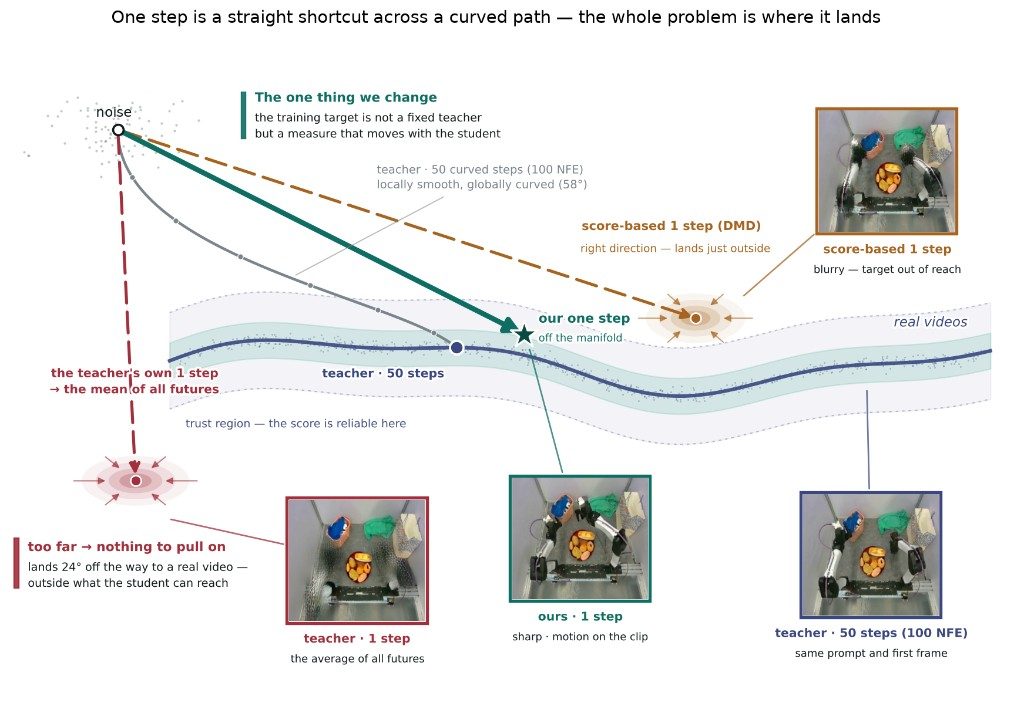
Figure 16. Why a single step is hard, and where each method lands. Frames are the final frame of one demo clip, same instruction and first frame across arms.
Inference cost drops by about 90×. On one H100 the sampler falls from 10,203 ms to 110 ms for a three-second, three-view manipulation video, a single network evaluation in place of the teacher's hundred. The table below sets that speed against quality on held-out episodes: our one-step student holds FVD at 121 and keeps flicker near real, where a teacher truncated to one step jitters badly (15.81); its motion, at 75% of real, is where it still trails the full teacher.
| Sampler | NFE | Sampler (ms) | Speedup | FVD ↓ | Motion ↑ | Flicker |
|---|---|---|---|---|---|---|
| Real recorded future | — | — | — | — | 100% | 2.37 |
| Teacher, default schedule | 100 | 10,203 | 1× | 80 | 94% | 2.69 |
| Teacher, steps cut to 1 | 2 | 210 | 48.6× | 1039 | 27% | 15.81 |
| DMD2, 2 steps | 2 | 211 | 48.4× | 115 | 79% | 2.95 |
| DMD2, 1 step | 1 | 109 | 93.6× | 599 | 56% | 5.81 |
| Ours, 1 step | 1 | 110 | 93× | 121 | 75% | 1.94 |
Figure 17. Dyna-2's one-step distillation pipeline can out-of-the-box generate high-fidelity, instruction-conditioned egocentric futures.
Figure 18. Multi-view, consistent futures from a robot-data post-trained Dyna-2 one-step distillation pipeline.
§ 5 Related Work
Scaling laws for robotics. Smooth power-law scaling of capability with data and compute is the organizing result of modern machine learning [10, 11], and its transfer-learning forms — effective data transferred [8] and alignment-dependent downstream scaling [9]. In robotics, scaling studies have measured generalization against environment and object diversity [12, 38], compute and model sizes [39], and, closest to this work, action-prediction loss against egocentric human data up to the ~20,000-hour scale [6]. Dyna-2 extends the measured axis by over two orders of magnitude and validates that scaling law holds for world-action models, holds it across four metrics, and, to our knowledge for the first time, demonstrates the same law zero-shot across the embodiment gap on robot data the model has never seen. EgoScale’s law [6] is measured on held-out human loss, with robot results obtained only after aligned human–robot mid-training; separately, recent foundation models demonstrate zero-shot cross-embodiment transfer at a single data scale [29, 30], establishing that transfer without adaptation is possible, but not how it scales; in these cases, robot-shaped data (e.g., UMI) remains in pre-training.
Robot foundation models and world-action models. One line of work builds generalist policies from vision-language models: RT-2 [13], OpenVLA [14], π0 [3], and GR00T N1 [15]; we compared Dyna-2 against our strongest internal VLA baseline under matched conditions. Building policies on top of video generation models is another line of work. Many works use video generation as a planner [16, 43] or a direct policy via fine-tuning [41], and, most directly related, joint world-action modeling [4, 5, 42]. Dyna-2 is a scalable architecture in the WAM category that can scale to millions of hours of data and demonstrates several novel scaling laws.
§ 6 Conclusion
We have introduced Dyna-2, a world-action model pre-trained on one million hours of human data. The architecture exhibits scaling law on held-out human data, and for the first time, proves that cross-embodiment transfer scaling law is possible. Furthermore, we demonstrate that world modeling is what propels the cross-embodiment generalization, and empirically establish video data as a new source of data for scaling. With just a few hours of fine-tuning data, Dyna-2 can perform complex manipulation tasks on robot embodiments never seen during pre-training. In addition, we showcase several capabilities of Dyna-2, including enhanced robustness, precision, instruction following, and one-step video generation. Overall, it is a significant improvement over our prior models. At the same time, it offers strong empirical evidence that helps answer some open questions in the field. One million hours is not the end of the scaling axis; it’s only the beginning of a new era of scaling for robotics.
§ References
@article{dyna2026dyna2,
  author = {{Dyna Robotics}},
  title  = {Dyna-2: A 1-Million-Hour Scaling Law
for World-Action Models},
  year   = {2026},
  month  = {August},
  url    = {https://dyna.co/dyna-2},
}